Understanding Your Local Road Inventory and Why It Matters
Your town’s road inventory is more than a list; it’s the foundation of smart highway management. It directly impacts how funds are allocated, how work is prioritized, and how infrastructure is maintained. By investing time in building and updating a complete inventory, towns position themselves for long-term success, fiscal efficiency, and better service to residents.

Every town maintains a network of roads that keeps the community connected, from residential streets to through-roads and rural routes. But how well does your municipality actually know its roads?
Keeping an up-to-date local road inventory isn’t just about having a list of street names. It’s a critical piece of municipal management, used for planning, budgeting, compliance, and state reporting. When maintained properly, a road inventory helps ensure that your town receives the funding it deserves and that its infrastructure remains safe and serviceable for residents.
Here’s why your local road inventory matters more than you might think.
What Is a Road Inventory?
A road inventory is a comprehensive record of all public roads that fall under a town’s responsibility. It typically includes:
-
Road names
-
Surface types (asphalt, gravel, etc.)
-
Width and length (centerline and lane miles)
-
Maintenance classification (local, county, state, private)
-
Pavement condition data
-
Functional classification (arterial, collector, local road)
-
Ownership and jurisdiction
-
Signage, bridges, and drainage features
Some towns track even more detail, especially if they’re using an asset management system.
Why an Accurate Inventory Is So Important
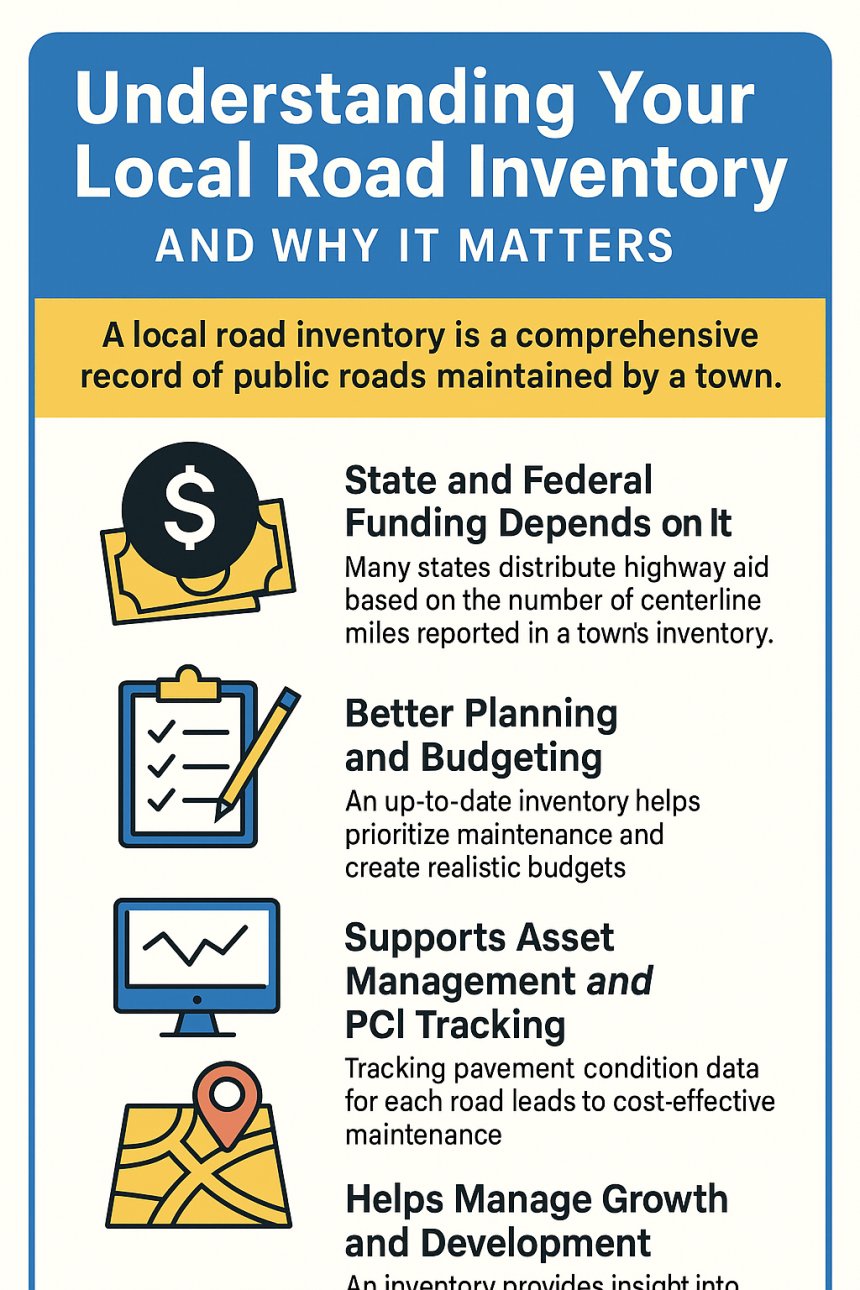
1. State and Federal Funding Depends on It
Many states, including New York, distribute highway aid based on how many centerline miles of road a municipality maintains. If your inventory is out of date or missing roads, your town could be missing out on CHIPS funding, PAVE-NY, Extreme Winter Recovery, or other reimbursements.
Even small discrepancies, like failing to include new subdivisions, can lead to lost dollars over time.
2. Better Planning and Budgeting
An accurate inventory allows highway superintendents and town boards to:
-
Prioritize road maintenance based on traffic volume and condition
-
Forecast paving schedules
-
Create realistic annual and capital budgets
-
Justify costs to residents and board members
You can’t plan for what you don’t know you have.
3. Supports Asset Management and PCI Tracking
Roads are assets, and like any asset, they deteriorate with age and use. When each road is properly logged in the inventory, towns can track:
-
When it was last paved
-
What treatments it’s received
-
Its current pavement condition index (PCI)
This data-driven approach leads to smarter, more cost-effective maintenance, instead of reacting to complaints or guesswork.
4. Improves Emergency Response and Public Communication
Knowing which roads are maintained by the town versus the county or state is important during:
-
Storm response and plowing
-
Utility coordination
-
Resident complaints and concerns
Having a clear, accessible inventory reduces confusion and speeds up decision-making.
5. Helps Manage Growth and Development
As new developments are built, roads are added, widened, or reclassified. The inventory must be updated accordingly to reflect:
-
Who is responsible for maintenance
-
Whether roads meet town standards
-
If new roads have been accepted into the public system
Keeping the inventory current ensures the town doesn’t get saddled with subpar infrastructure or unexpected maintenance responsibilities.
Who Maintains the Inventory?
Typically, the highway superintendent is responsible for maintaining the road inventory and submitting annual updates to the state. However, input often comes from:
-
Town engineers or planning departments
-
GIS coordinators
-
Consultants or asset management platforms
-
Board members or administrative staff
Collaboration across departments ensures accuracy and consistency.
Your town’s road inventory is more than a list. It’s the foundation of smart highway management. It directly impacts how funds are allocated, how work is prioritized, and how infrastructure is maintained.
By investing time in building and updating a complete inventory, towns position themselves for long-term success, fiscal efficiency, and better service to residents.
Because in local government, knowing what you have is the first step to taking care of it.